Resume format for freshers and experienced candidates (2026)
The right resume format depends on how much experience you have. Freshers lead with education and projects on one page; experienced candidates lead with results from their recent jobs. This guide compares the three standard formats, gives a section-by-section outline for each case, and explains how a resume differs from a CV and a biodata.
Chronological, functional or combination
Chronological
Your jobs in reverse date order, latest first, each with bullets about what you did and achieved. Recruiters and applicant tracking systems (ATS) read it most easily. Use it if you have steady experience in the field you are applying to.
Functional
Skills grouped by theme first, with a short job list or none at all. It can hide gaps, and that is why recruiters often distrust it. Use it rarely, if ever.
Combination
A strong skills summary at the top, then your experience in reverse date order. A good choice for career changers, people returning after a break and freshers with projects and internships to show.
What a good format looks like
Format is the order of your sections; layout is how they sit on the page. Any of these layouts works with a chronological or combination format. Pick a calm one for banks, government and large IT services companies, and a more designed one for startups, marketing and design roles.
If you are a fresher, keep your resume to one page. Recruiters spend well under a minute on a first read, and campus drives bring them hundreds of resumes at once. One page forces you to keep only what matters for the role: your degree and score, your best two or three projects or internships, and the skills the job description asks for.
Cut what repeats or does not help: a long list of soft skills without proof, every school competition, a declaration paragraph and a list of hobbies with nothing to say about them. After three to five years of work, a second page is fine if every line earns its place.
Fresher resume format, section by section
Header
Name, phone, professional email, city, and a LinkedIn or GitHub link if it is up to date. No photo, date of birth or father’s name unless asked.
Career objective or summary
Two or three lines: your degree, the role you want and your two strongest skills. “B.Tech Computer Science graduate looking for a software developer role, strong in Java and SQL.”
Education
Degree, college, year and CGPA or percentage, then class XII and X with board and score. Most recent first.
Projects and internships
Two or three, each with what you built or did, the tools used and a result: users, accuracy, a grade or a prize.
Skills
Technical skills first (languages, tools, software), then a few soft skills you can prove elsewhere on the page.
Certifications and achievements
Online courses that match the job, hackathons, NSS or NCC, sports and leadership roles.
Languages
English and the other languages you speak, with your level. Useful for customer-facing and BPO roles.
Three or four lines: years of experience, your field, your strongest skills and one result you are proud of.
Work experience
Each job in reverse date order with title, company, dates and three to five bullets that start with a verb and include a number: revenue, time saved, team size, targets met.
Skills
Tools, methods and domain knowledge that match the job description.
Education
Degree, college and year. Drop school marks once you have a few years of work.
Resume: a one- or two-page summary of your education, skills and experience, written for one kind of job. This is what private companies in India and most of the world ask for.
CV: in India, the UK, the Gulf and Europe, “CV” means the same thing as a resume. In the US and in academia, a CV is a longer record with publications, research and teaching.
Biodata: a resume plus personal details such as date of birth, gender, nationality, religion and family. It is used for some government applications and for marriage proposals. Do not send a biodata format for a private-sector job unless the employer asks for those details.
What an ATS reads
Many companies and job portals pass your resume through an applicant tracking system (ATS) before a person sees it. The software pulls out your text, splits it into sections and matches it with the job description. To make that work:
Send a text-based PDF or Word file, not a photo or a scan. If you can select the words in the PDF, software can read them.
Use standard section titles such as Experience, Education and Skills.
Use the same words as the job description for skills you really have, such as “Python”, “Tally” or “customer support”.
Write dates the same way everywhere, for example “Jun 2024 – Present”.
Keep contact details in the main text of the page, not only inside an image.
Questions
Which resume format is best for freshers?
A one-page reverse-chronological format with education near the top. Put your career objective or summary first, then education, projects and internships, skills, and certifications. It is the format recruiters and campus placement cells expect.
Should a fresher resume be one page?
Yes. With no full-time work history, one page holds everything a recruiter needs. A second page usually means repeated skills or school details that do not help.
What is the difference between a biodata, a CV and a resume?
A resume is a short one- or two-page summary for a job application. A CV is the same thing in most countries, and a longer academic record in the US. A biodata adds personal details such as date of birth, family and religion; it is used for government forms and marriage proposals, not for private-sector jobs.
Should I add a photo, date of birth or marital status to my resume?
For private-sector jobs in India, the US and the UK, leave them out unless the job advertisement asks for them. Recruiters decide on skills and experience. Some Gulf and European employers still expect a photo, so follow the norm of the country you apply to.
Which file format should I send my resume in?
A PDF, unless the job portal asks for a Word file. A PDF keeps your layout the same on every screen. Name it with your name and the role, for example Priya-Sharma-Data-Analyst.pdf.
Noga CV puts your sections in a clean order for you. Pick one of 34 templates, ask AI for suggestions for your summary, experience and skills, check your CV score, and download an A4 PDF. No account needed, and the app interface is in English.
 Noga CV
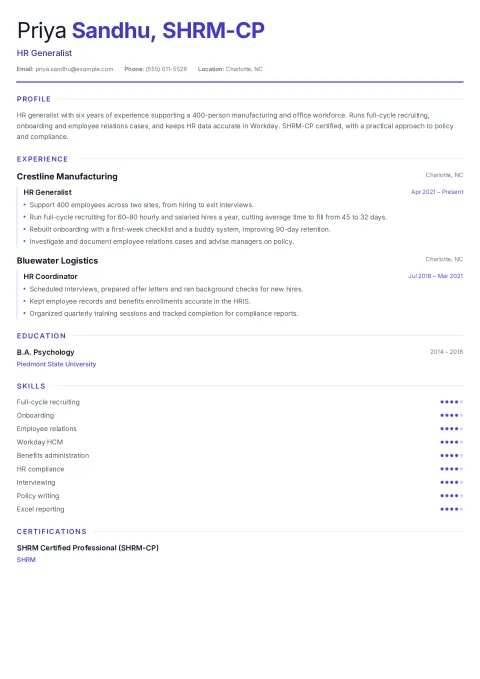 Single column
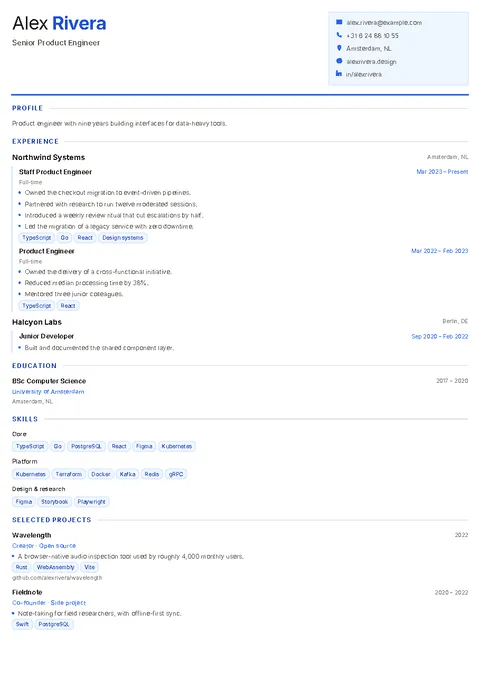 Header
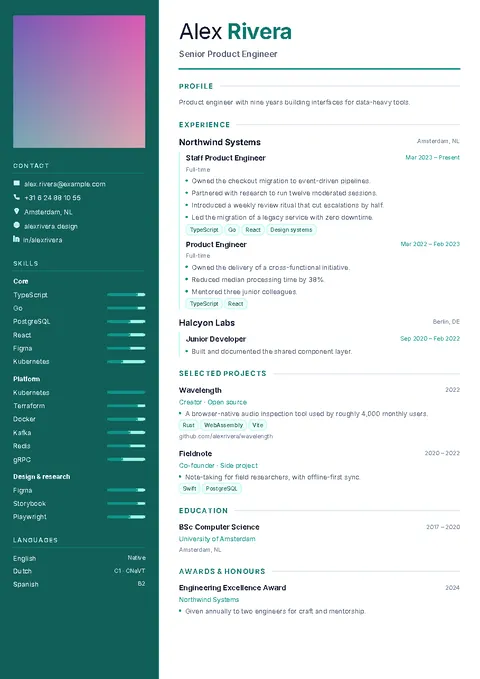 Sidebar